
The Seven Grandfather Teachings are one of the most cherished wisdom frameworks among many Eastern Woodlands Indigenous nations—especially the Anishinaabe (Ojibwe, Odawa, Potawatomi). These teachings sit right at the heart of the land named Michigan.
They’re not just virtues—they’re a way of life, a path to becoming a whole human being, and a guide for living in right relationship with Creator, self, others, and creation.
Here they are in their traditional form:
The 7 Grandfather Teachings

1. Wisdom (Beaver) — Nibwaakaawin
To use knowledge for the good of all.
To understand the deeper meaning of life and act with sound judgment.
The Beaver serves as a teacher of wisdom through its natural behavior and industriousness.
Using Natural Gifts: The Beaver is gifted with sharp teeth and uses them wisely to cut trees and build dams. This teaches that everyone has a unique gift from the Creator, and wisdom is found by using those inherent gifts for a positive purpose.
Community Impact: By building dams and lodges, the Beaver alters its environment in a sustainable way that benefits its family and the surrounding community.
Self-Sustenance: If a Beaver does not use its teeth, they will continue to grow until they become useless, eventually making it impossible for the animal to survive. This illustrates that a human spirit can grow weak if it does not fulfill its intended use and purpose.
Cherishing Knowledge: To "cherish knowledge is to know wisdom". The gift of wisdom allows people to use their knowledge and judgment to achieve positive outcomes and live a "good life" (minobimaadizi).

2. Love (Eagle) — Zaagidiwin
In the Grandfather Teachings, Love is understood as a fundamental, sacred force that forms the foundation of all right relationships—with the self, family, community, and all of creation. It is not merely a feeling, but a principle of interconnectedness and unconditional care.
The Sacred Force that Binds all Things
This teaching is visually represented in the detailed wood carving, which places Love at its very center. The core concept is that Love is the "sacred force that binds all things." This binding nature is shown in the intricate heart-knot pattern within the central emblem, demonstrating how diverse elements are woven together into a single, unified whole.
A Path of Action and Connection
The banners radiating from the central eagle define Love not as a passive emotion, but as a deliberate path: "Acts of kindness, respect, & connection." This emphasizes that true Love is demonstrated through what we do. The teaching directs this care outward and inward: "Cherish your self, your family, your clan, & creation." By practicing Love, we strengthen the bonds that keep individuals and communities balanced and healthy.
Foundational to all Living
The visual composition reinforces that Love is central to a balanced life. The other teachings surrounding it (Honesty, Bravery, Humility, Respect, Wisdom, and Truth) are, in essence, different expressions or applications of this core principle. Love provides the "why" behind living with integrity and wisdom. Its ultimate source and purpose are rooted in "Kitchi Manitou" (Great Spirit/Creator), making the pursuit of Love a spiritual imperative for harmonious living.

3. Respect (Buffalo)— Minwaadendimowin
In the Seven Grandfather Teachings, a set of foundational Anishinaabe principles for living a good life, Respect (Minwaadendimowin) is embodied by the Buffalo. The Buffalo serves as a powerful model of unconditional giving, balance, and honor for all creation.
Here is an explanation of why the Buffalo is the symbol of Respect:
1. The Ultimate Gift of Sustenance
The Buffalo is respected because it gave every part of itself to ensure the survival of the people. Historically, Indigenous communities on the Plains relied on the buffalo not just for food, but for shelter (hides for tipis), clothing, tools (bones and horns), and spiritual materials.
This act of giving, without withholding anything, is a profound expression of respect for the continuation of life. It teaches that true respect means contributing to the well-being of others and the community, often selflessly.
2. Living in Balance with Creation
The Buffalo is recognized for its reciprocal relationship with the environment. It moves across the land in a way that allows the grasslands to rejuvenate, showing respect for the balance of nature.
The teaching associated with the Buffalo emphasizes that we must respect all living things equally—from the smallest plant to the largest animal, including all people. We show respect by "going easy" and avoiding wastefulness, ensuring that we only take what is needed and honoring what is given.
3. A Mirror for Human Behavior
The visual representation you've shared reinforces these concepts. The central figure is a massive Buffalo head, flanked by scenes of human life that embody its lessons:
-
Community Stewardship: Humans are shown taking care of the land, which in turn sustains them and the buffalo herd.
-
Harmonious Balance: A scene depicts people working together to maintain a sustainable community and farm, reflecting the cooperative spirit of the herd.
-
Honor and Giving: Text banners command us to "Honor all creation, do not waste" and to "Give of yourself, treat others as you wish." These are direct applications of the buffalo's way of life to human interactions.
The Buffalo reminds us that by honoring creation, being selfless caretakers, and living without waste, we fulfill the law of Respect and contribute to a harmonious, balanced world.

4. Bravery / Courage (Bear) — Aakodewewin
In the Seven Grandfather Teachings, Bravery or Courage (Aakwade’ewin or Zhewaakenh) is represented by the Bear. The Bear teaches us how to face the challenges of life with a steady heart and moral strength.
The Core of the Teaching: Facing Fear
The visual representation of this teaching emphasizes that bravery is not the absence of fear, but the ability to act correctly despite it.
-
Acting Despite Fear: As shown in the central banners, true bravery is "acting despite fear" and "defying fear" to do what is necessary.
-
The Heart of Bravery: The teaching suggests that "the heart of bravery is truth," meaning that the most courageous acts often involve standing up for what is right even when it is difficult.
-
Protection: The Bear is a fierce protector of its young and its territory, teaching us to have a "brave spirit" when it comes to "protecting the people" and the community.
Everyday Courage
Bravery is not always a grand, singular event; it is often found in daily choices.
-
Choosing Right Action: Courage is reflected in "choosing right action" and having the strength to "stand against adversity".
-
Speaking the Truth: One of the most important forms of bravery is "speaking the truth," even when it may be unpopular or uncomfortable.
-
Unity in Challenge: The teaching encourages "unity in challenge," showing that we are often bravest when we support one another and "act without hesitation for your people".
-
By following the path of the Bear, we learn to find the inner strength needed to live with integrity, protect the vulnerable, and remain true to our values regardless of the obstacles we face.

5. Generosity (Moose) - Miigwe’aadiziwin
The Moose visualizes generosity not as an optional act, but as a foundational principle of life, community sustainability, and connection.
The Ultimate Act: Sharing without MeasureThe Buffalo is also associated with generosity through sacrifice. However, in this specific composition, the Moose is elevated as the primary symbol, flanked by the buffalo to emphasize that generosity is paramount. This emphasizes that to receive sustenance, you must give of your own talents and time.
The visual teaching suggests:
1. A Call to Action:
Generosity begins at home" and is a "giving without measure."True Wealth: When we "share from the heart," the entire "community is sustained," and we realize that "in share, all thrive.
The Sacrifice: The Moose gives "unconditional giving" of its parts—antlers for tools, meat, and hide—mirroring how humans must give of their inner and outer gifts.
2. Sustainment and Community,
The large carving is divided into scenes that illustrate how generosity supports the structure of life.
Sustaining the Community: The bottom section depicts humans gathering together. In one scene, they hold blankets and supplies for a give-away (Potlatch), while another shows the community actively "sharing all gifts." These acts ensure no one is left behind.
The Abundance Cycle: A central scene illustrates a man, woman, and children tending a "circle of abundance" (the Three Sisters crops: corn, beans, and squash). Generosity is the mechanism by which abundance is generated and distributed.
Everyday Acts: Generosity is not limited to grand events; it is found in "everyday generosity" where individuals perform small acts of service and sharing, connecting them to "Kitchi Manitou" (the Great Spirit/Creator).The Moose reminds us that when we give without withholding, we honor our own connection to the Creator and ensure that the collective community can thrive.

6. Humility (Wolf) — Dbaadendiziwin
The Wolf teaches us about balance and our true place within creation, reminding us that no single individual is more important than the collective, yet everyone has a role.
The Inner Journey
The complex visual narrative you’ve shared places Humility at the very center, emphasizing its foundational role. The core teaching is that true balance is an internal state:
-
Begins Within: As the carved banner declares, "Dibaadendiziwin begins within." This internal focus allows us to cultivate a "life of balance" and correctly assess our own strengths and weaknesses.
-
The Collective Heart: The central Wolf's chest contains a complex heart-knot that binds together many figures—a wolf cub, a human child, a community, and diverse animal clans. This visually represents the fundamental principle of interconnectedness.
Humility in Action
The surrounding scenes illustrate how this internal understanding translates into everyday action within the community.
-
Service Before Self: One section shows humans raising a traditional wigwam, demonstrating that the community is built and sustained through collective effort and "service before self".
-
Learning and Praise: A scene of a woman and child tending to plants teaches the cycle of learning from elders and the land. In this process, we learn to "give praise, not self-praise," acknowledging that our gifts are from the Creator.
-
Recognizing Your Place: A large group gathering at the bottom shows a balanced council of all generations, embodying the wisdom of "recognizing your place" as an equal contributor to the community's whole.
-
Everyday Humility: Small carved scenes illustrate "everyday humility" through individual acts of kindness, mentorship, and support that connect to Kitchi Manitou (the Great Spirit/Creator).
The Wolf reminds us that by being humble caretakers of one another and the land, we achieve true balance and connection to all living things.
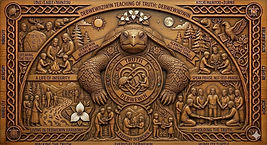
7. Truth (Turtle) — Debwewin
The turtle represents the Grandfather Teaching of truth. This teaching explains how to live a life of integrity by remaining faithful to all of the Creator's natural laws.
I. The Symbolism of the Turtle
The Turtle is chosen to represent Truth because it carries the weight of all creation on its back and understands the eternal nature of the divine laws.
-
Patience and the Journey: The central large Turtle reminds us that truth is both a destination and a slow, meticulous journey. We must live "a life of integrity" at a pace that allows us to conscientious about every action.
-
A Power Greater Than Ourselves: The large circle on the turtle's back visually binds together diverse figures—a turtle elder, a human child, and many clans—under the name "TRUTH." This represents that truth "allows you to believe that a Power greater than ourselves" connects all living things.
-
Bearing Witness: The 13 inner scutes of the Turtle's shell represent the 13 moons of the year, while the 28 outer scales represent the lunar cycle. This means the Turtle is always present, "bearing witness" to the passage of time and the unchanging nature of the sacred laws.
II. The Core of the Teaching: Debwewin
The visual elements in the carving define Debwewin as more than just facts; it is a way of being.
-
Begins Within: As the carved banner declares, "Debwewin begins within." To know truth is first to "know and understand all of the original laws" and remain faithful to them in your own heart.
-
Walking the Truth: Truth is a path. The scene in the lower-left corner depicts footprints of many species walking together along a shared path toward a sacred white trillium flower, labeled "walking the truth." This is the practice of "living in Debwewin harmony" with all of creation.
-
Speaking and Upholding: The scenes of councils, handshakes, and individuals standing together illustrate the responsibility to "speak praise, not self-praise" and to maintain your loyalty in all relationships by "upholding the truth.
-
"Everyday Acts: The bottom-most section shows individuals in everyday activities—fishing, carrying resources, caring for children—labeled "everyday Debwewin." This demonstrates that truth is a consistent practice, an invisible architecture that supports the entire community's structure.
The teaching of the Turtle shows us that by cultivating truth within, walking in balance, and honoring our connection to all living things, we fulfill our purpose and connect to Kitchi Manitou (the Great Spirit/Creator).
Quick Reference
Nibwaakaawin — nih‑bwah‑KAA‑win
Zaagidiwin — ZAH‑gee‑dih‑win
Minwaadendimowin — min‑WAA‑den‑dih‑moh‑win
Aakodewewin — ah‑koh‑DAY‑we-win
Miigwe’aadiziwin— Me-gway‑ah‑DIH‑zih‑win
Dbaadendiziwin — duh‑BAA‑den‑dih‑zih‑win
Debwewin — DEB‑way‑win
Section Title
This is a Paragraph. Click on "Edit Text" or double click on the text box to start editing the content and make sure to add any relevant details or information that you want to share with your visitors.